
Thank You for Showing Up!
On May 1, 2026, the legal profession stood together for the rule of law.
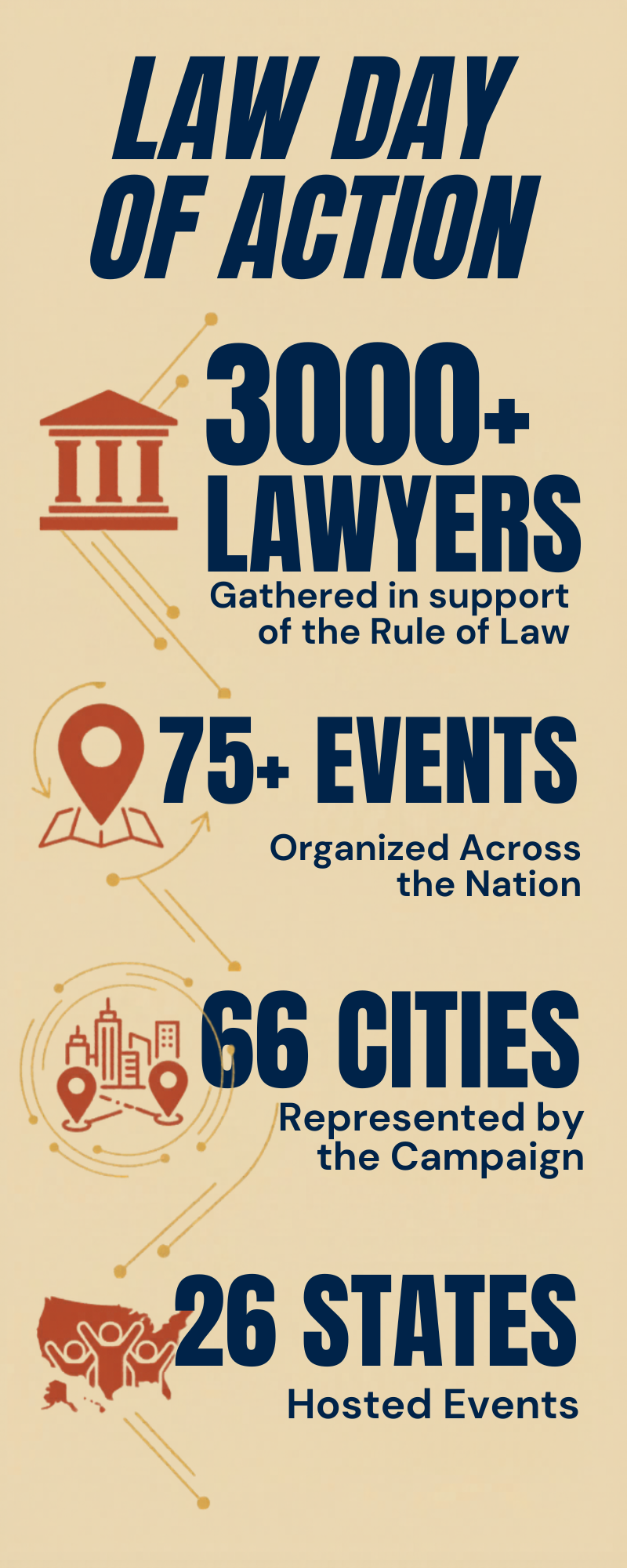
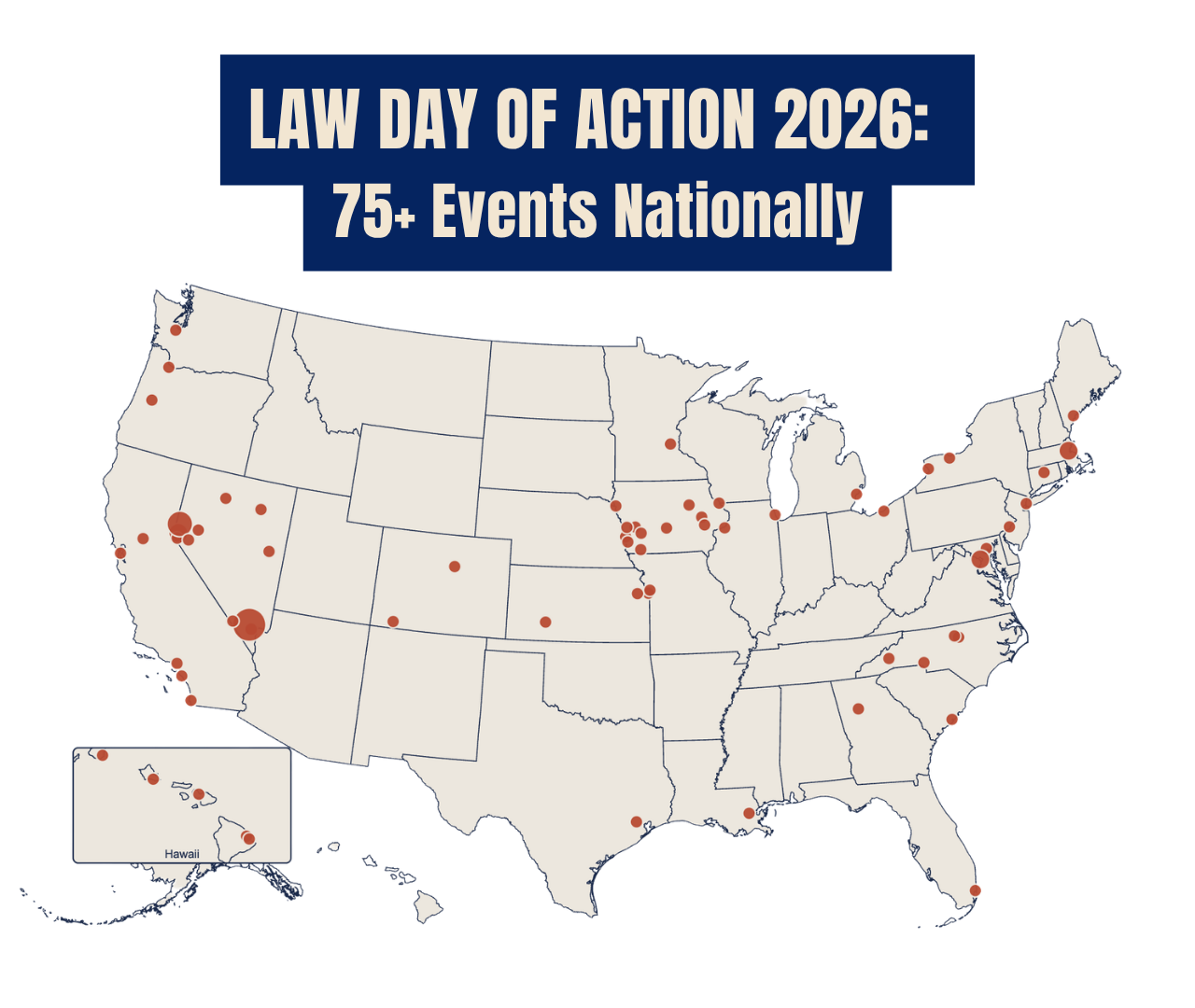
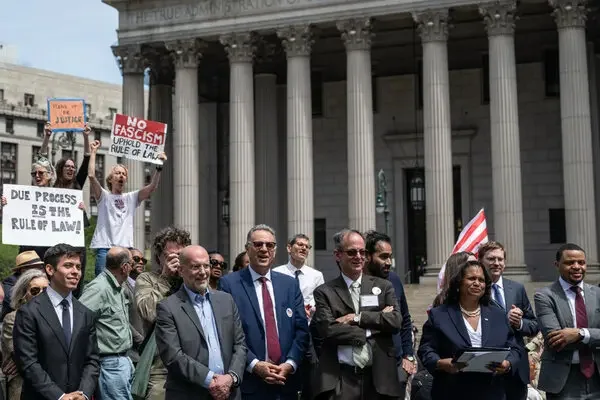
From the steps of the U.S. Supreme Court to courthouses, plazas, and bar association halls in more than 70 cities across 25 states, lawyers, judges, and legal advocates publicly reaffirmed our oath to the Constitution.
This year's mobilization was distinguished by the depth of institutional support — sitting and former judges, state Supreme Court justices, members of Congress, bar association presidents, law school deans, and thousands of practicing attorneys stood together, across every region and every practice area.
What is Law Day of Action 2026?
Law Day of Action is a nationwide, nonpartisan moment when lawyers and judges join with citizens to publicly recommit to the constitutional principles that protect everyone: equal justice under law, courts free from political interference, and due process for all.
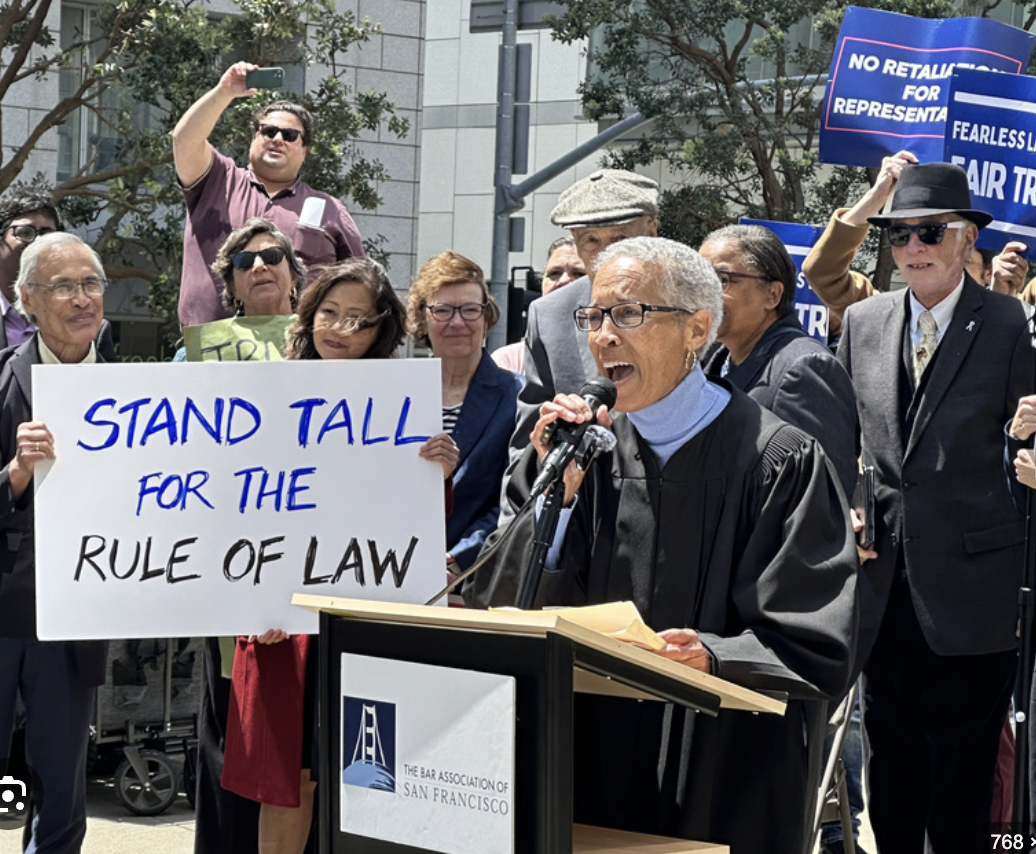
On Friday, May 1, 2026, legal professionals in cities across America will gather at courthouses to ceremonially retake their professional oaths—making visible our collective commitment to a legal system that serves the Constitution, not partisanship or political pressure.
Why It Matters Now
As we approach 250 years of constitutional democracy, the institutions that have made that experiment durable are under direct threat.
Our justice system depends on three pillars:
Independent courts where judges decide cases based on law, not political pressure
Judicial authority that is respected even when rulings are unpopular or politically inconvenient
Equal treatment under the law where the rules apply the same way to everyone, so that our Constitutional rights are protected
All three face serious and escalating threats.
US attorneys' offices nationwide have been directed to identify judges whose rulings might warrant impeachment referrals to Congress. Federal court orders requiring due process protections in immigration enforcement have been openly defied. And lawyers who defend unpopular clients or constitutional principles face professional consequences and coordinated harassment.
These threats aren't about individual cases or political outcomes. They're about undermining the checks and balances that protect everyone’s liberties and personal safety.
The legal profession has a unique responsibility and capacity to help Americans defend these institutions. When lawyers stay silent, the public interprets our silence as acceptance. When we show up together, we make clear that these principles are non-negotiable.
Three Ways to Participate
ATTEND
Find a Law Day of Action event near you and show up for the rule of law.
The National Map of events is open and available above. If your city is missing and you’d like to indicate your interest in attending or organizing an event near you, click the Indicate Your Interest button below.
ORGANIZE
You don't need a big budget or a committee. You need a location, 30 minutes, and the willingness to show up. We'll handle national promotion, materials, and support.
JUDGE
Sitting and former judges play a unique role in Law Day of Action — administering oaths, lending institutional voice, and making visible that the judiciary itself is paying attention.
Core Principles
Every Law Day of Action event is grounded
in these shared commitments:
Equal Justice
Under Law
The promise that legal protections apply equally to everyone, regardless of who you are or who's in power. When this fails, nobody is truly protected.
Judicial Independence
Courts must be free to decide cases based on law and evidence, not political pressure or fear of retaliation. An independent judiciary protects everyone's rights, especially when they're unpopular.
Checks and Balances
No one—not the President, not Congress, not any official—is above the law. The constitutional structure that prevents concentrated power protects us all.
Professional Integrity
Lawyers take an oath to uphold the Constitution and defend the rule of law. That oath doesn't expire when it becomes uncomfortable.
Due Process
Government power must operate through established legal procedures, not executive decree. Due process protections—the right to be heard, to challenge government action, to have decisions made through lawful procedures—are what separate the rule of law from arbitrary power.
This Is Not Political. It's Professional.
Law Day of Action is explicitly nonpartisan. We are not advocating for any political party, candidate, or policy outcome.
We are standing up for the system that has been foundational to our liberty and prosperity: one that is insulated from political pressure, includes constitutional limits on power, and promises equal justice under law. We know our legal system has fallen short of its promises for too many people throughout our history, but it is our constitutional framework that makes reform possible and protects everyone from arbitrary power. When that framework is undermined, no one can seek justice or accountability.
These principles have sustained our constitutional republic for nearly 250 years. They have defenders across the ideological spectrum. They matter whether you're conservative, progressive, or anywhere in between. They protect everyone.
For Event Organizers
Why Organize an Event?
Because visible moments matter. When lawyers gather publicly to reaffirm our oaths across America on the same day, it sends a powerful message to the public: the legal profession is present, committed, and sounding the alarm.
Because collective action is stronger than individual voices. When bar associations, legal organizations, and lawyers across the country show up together in cities across the country, it demonstrates that these principles transcend partisan divides.
Because silence is interpreted as consent. At a time when judicial independence and professional integrity face direct threats, inaction signals acceptance. Showing up publicly and together signals otherwise.
Once you register your event, we promote it to tens of thousands of lawyers and legal professionals nationwide. Your job is to show up and lead. We handle the rest.
A Successful Event Can Be:
15 lawyers on courthouse steps, 30 minutes, one photo
A bar association rally with speakers and media
A coalition event with CLE programming and public engagement
You decide the scale. We provide the framework, the materials, and the audience.
Learn How to Organize Here
What We Provide
National Coordination & Resources:
Messaging toolkit and talking points
Coalition calls to learn from peer organizers in the lead-up to Law Day on May 1
Sample run-of-show for different event scales
Graphics, sample signage, and social media templates
Connection to other organizers and potential event participants in your region
Tips on working with local media, and national press outreach to amplify local coverage
Guardrails & Standards:
Clear nonpartisan messaging guidelines
Shared principles that all participating organizations agree to uphold
Sample speaker prompts to ensure events remain nonpartisan and focused on institutional principles; all local event organizers should vet their own event’s speakers
What You Control
Local organizers have full autonomy over:
Event location and logistics
Level of production (baseline, medium, or something else)
Who speaks
Local coalition partners
Outreach and turnout strategy
Whether and how to engage media
You know your community. We provide the framework; you bring the local knowledge and relationships that make it work.
Who Can Organize?
Bar associations (city, county, state, specialty, affinity groups)
Lawyers acting as individual organizers or helping to lead their bar associations (we'll connect you with others in your area)
Legal aid organizations and public interest groups
Law school student organizations
Coalitions of legal and civic organizations
You don't need to be a large organization. You need commitment to the core principles and willingness to show up.
Organizing Without Your Bar Association
You don't need institutional backing to organize a Law Day of Action event. Many successful 2025 events were organized by individual lawyers or small groups when local bar associations weren't ready to take the lead. See above for what we provide by way of resources.
For Lawyers & Judges
Why You Should Participate
Your oath means something. When you were admitted to the bar, you swore to uphold the Constitution and support the rule of law. Law Day of Action is a public renewal of that commitment: a reminder that the oath doesn't expire when it becomes difficult.
This is your professional responsibility. The legal system depends on the integrity and independence of the lawyers who operate within it. When that system is under threat, staying
Judges and lawyers are being targeted for doing their jobs. Across the country, judges face threats for lawful rulings, court orders are defied, and legal professionals defending constitutional principles face harassment. When we stand together, we make clear that these attacks are unacceptable.
The public needs to see the profession defend its institutions. Trust in courts and lawyers is strained. When legal professionals visibly affirm our commitment to fairness and the rule of law, it rebuilds public confidence that the system still has defenders.
This is bigger than any single case or controversy. We're not advocating for political outcomes. We're standing for the process that protects everyone's rights and limits concentrated power.
What Participation Looks Like
At the event:
Show up in professional attire (courtroom dress code or robes)
Stand with fellow lawyers and judges
Participate in the ceremonial oath-taking or constitutional affirmation
Be part of the group photo
That's it. No speeches required, no political litmus test, no pressure to do anything beyond reaffirming your professional commitment.
For Judges
Sitting and former judges occupy a unique position in Law Day of Action. We recognize sitting judges must maintain impartiality and avoid any appearance of partisanship. Law Day of Action is designed with this in mind.
Events are explicitly focused on defending institutional principles—judicial independence, equal justice under law, and constitutional limits on power—not supporting or opposing any political party or candidate
Judges participate by reaffirming their judicial oath—a completely appropriate professional act
Speakers may describe specific threats to judicial independence (including naming when judges have been threatened, court orders defied, or the judiciary attacked) without advocating for political outcomes
The focus is on the independence of the judiciary itself, which judges are uniquely positioned to defend
Many sitting judges participated in Law Day of Action 2025 because defending judicial independence is not political—it's definitional to the role.
If you're interested in administering the oath at a local event, we'll connect you with organizers in your community. You don't have to find the event — we'll find it for you.
If you have concerns about participation, we encourage you to:
Review the event messaging guidelines (available to organizers)
Speak with your local event organizers about how the event will be framed
Consult with judicial ethics resources in your jurisdiction
We've designed this to be a moment judges can participate in with full integrity.
For the Public
Why Should You Care?
Because the rule of law protects your rights—all of them.
When courts are independent, you can challenge government overreach. When lawyers can represent unpopular clients without fear, your rights are protected even when they're inconvenient to power. When the legal system operates fairly, you have recourse when you're wronged.
When these protections erode, everyone loses—regardless of political affiliation.
Law Day of Action isn't lawyers protecting their own interests. It's the legal profession standing up for a system that serves everyone: fair trials, equal treatment under the law, and constitutional limits on government power.
The rule of law is the inheritance of 250 years of American constitutional democracy. It doesn't protect itself.
What You Can Do
1. Attend a local Law Day of Action event Show up and witness lawyers publicly recommitting to the principles that protect you. Your presence matters.
2. Learn about judicial independence and why it matters Understanding how the legal system works, and why its independence is essential, helps you recognize and resist efforts to undermine it.
3. Support organizations defending the rule of law Many nonprofit legal organizations are working to protect judicial independence, defend lawyers facing retaliation, and ensure equal access to justice.
4. Hold elected officials accountable When officials attack judges for lawful rulings or interfere with the legal profession, speak up. Let them know you value an independent judiciary and a legal system free from political interference.
Frequently Asked Questions
-
No. Law Day of Action is a professional reaffirmation of oath and principle, not a protest. It's lawyers doing what we're trained to do: publicly supporting the institutional framework that protects everyone's rights.
-
Because the threats to judicial independence and the rule of law are direct, escalating, and ongoing. Judges are being threatened with impeachment and even violence for issuing lawful rulings. Court orders are being ignored. Lawyers who defend constitutional principles face coordinated harassment and professional consequences.
These aren't one-time incidents from the past—they represent an ongoing pattern of attacks on the institutions that limit power and protect rights.
When the system is under active assault, waiting is complicity.
-
Yes. While the core participants are lawyers and judges, many Law Day of Action events welcome members of the public, law students, and other "oath-takers" (veterans, former government officials) who share commitment to constitutional principles.
Check with your local event organizer about their specific format.
-
Some will interpret any visible action as political. That's unavoidable when institutional norms themselves become contested.
But there's a crucial difference between defending the system and advocating within it. We're not arguing for policy outcomes or political positions. We're standing for the structural principles that allow policy debates to happen fairly: independent courts, constitutional limits on power, and equal justice under law.
Throughout American history, defending these principles has sometimes required visible action. This is one of those moments.
-
Law Day of Action isn't about political agreement; it's about shared commitment to the system itself. You'll likely stand next to lawyers with whom you may disagree with on policy. That's exactly the point: these principles transcend those disagreements.
-
Traditional Law Day (established in 1958) is a general commemoration of the rule of law, often featuring educational programs, essay contests, and courthouse open houses.
Law Day of Action adds urgency and visibility. It's a direct response to specific, ongoing threats to judicial independence and the legal profession. While it maintains Law Day's focus on constitutional principles, it's more explicitly a moment of collective professional commitment in response to active assault on the system.
-
Law Day of Action is one visible moment in a longer commitment. Many participating organizations will continue working to:
Defend judges and lawyers facing retaliation
Support legislative efforts to protect judicial independence
Provide pro bono legal representation in rule-of-law cases
Educate the public about threats to the legal system
Hold elected officials accountable when they attack courts or lawyers
The oath we take on May 1 extends beyond that day.